
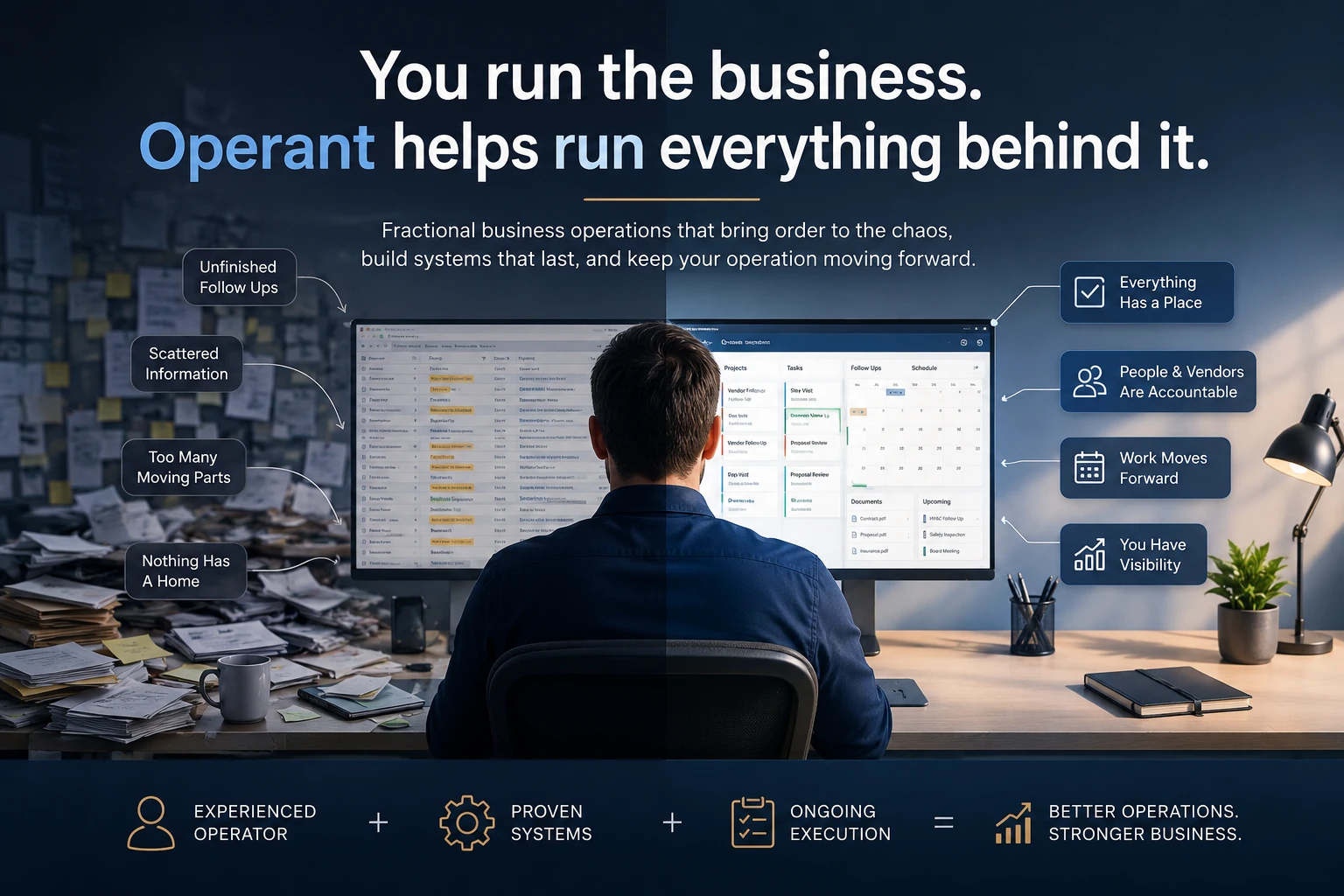
Operant sits between the owner and the moving pieces of the business—turning requests, promises, deadlines, documents, projects, and recurring responsibilities into organized work that stays visible until it is finished.
Not consulting. Not a virtual assistant. Not software you have to operate.
Judgment and ownership
Someone who understands operations identifies priorities, resolves exceptions, coordinates people, and helps make sure the right work moves.
Structure and visibility
Projects, commitments, vendors, documents, recurring work, decisions, and history are brought into a system built around your business.
Follow-through that continues
Operant does not hand you recommendations and leave. The system is actively used to organize, track, follow up, report, and improve the operation.
What does Operant actually handle?
The exact system is built around each business, but this is the kind of work that commonly consumes an owner's attention.
Projects & follow-through
Turn conversations and ideas into assigned work with deadlines, dependencies, next actions, and continuing follow-up.
Vendors & contractors
Organize quotes, commitments, service history, open issues, contracts, and follow-ups until the work is resolved.
Scheduling & recurring operations
Create structure around inspections, maintenance, meetings, renewals, compliance dates, and repeating responsibilities.
Documents & operational records
Give contracts, procedures, proposals, service records, and project information a place where they can be found and used.
SOPs, research & purchasing
Document repeatable processes, research solutions, collect options and quotes, and prepare decisions for the owner.
Reporting & visibility
Show what happened, what is late, what is waiting on someone else, and what genuinely requires the owner's attention.
The business stops operating from the owner's memory.
Before Operant
- Requests live in email and text messages
- Vendor promises are difficult to track
- Projects have no single current status
- Procedures live in employees' heads
- Recurring responsibilities depend on memory
- The owner has to find out what happened
With Operant
- Work is structured and remains visible
- Responsibilities and next actions are clear
- Waiting-on items receive follow-up
- Decisions and activity create history
- Recurring work has a dependable schedule
- The owner sees only what needs attention
Just tell Operant what happened.
The Operations Concierge is the owner's private front door. You speak naturally; Operant creates the operational structure behind the request.
You do not have to create a project, update a spreadsheet, choose a status, or remember the follow-up date yourself.
Experience This in the Sandbox →You are not hiring an AI.
You are hiring an experienced operator who uses modern technology to receive information, organize it, retrieve it, summarize it, and automate appropriate workflows. Operational judgment, priorities, exceptions, and business decisions retain human oversight.
AI receives and structures
Natural-language updates become organized operational records and actionable work.
The operator directs and executes
Priorities, context, people, exceptions, and follow-through receive experienced human judgment.
The owner stays informed
The owner sees what matters without personally carrying every open loop.
Build the foundation. Operate it in the real business. Decide from experience.
Understand & build
Learn the business, identify the operational load, and build the initial environment around real responsibilities, projects, vendors, and information.
Operate & improve
Use the system in daily operations. Move work, follow up, develop procedures, improve visibility, and adapt the structure around reality.
Continue or receive a handoff
Continue by mutual agreement or receive the agreed client-specific data, procedures, configurations, and exportable or deployable materials defined in the service agreement.
Give Operant one real operational problem.
In a few minutes, see how your situation becomes structured work and a clearer operating picture.